


Dear Apple Marcom CTG,
I build tools for creative people.
I'm a AI creative technologist and film director with an MA in Interaction Design. My work spans software development, generative AI, virtual production, game engines and experimental LLM systems.
I co-founded and co-built Borderland, an app for long-form writers now in public TestFlight alpha, and created VisionFrame, a generative AI tool for filmmakers, used in commercial production.
My background is in storytelling. I've directed global campaigns for clients including adidas and Mercedes-Benz, leading multidisciplinary teams from initial pitch through production to final delivery. It's taught me how to bring people together, navigate complex challenges and protect the creative vision.
What interests me most now is building useful products and creative tools.
My approach starts with the user. What are they trying to accomplish? What problem needs solving? And ultimately, why should anyone care?
Borderland
A daily ritual app for long-form writers. macOS & iOS.
I wanted to build a minimalist writing editor. But interviews with novelists, screenwriters and playwrights, using the Jobs to Be Done framework, revealed a more important problem: the cold start of returning to a writing project.
Borderland shows writers where they left off, what mattered, and what comes next. A quick daily brief and debrief, an automated creative journal and idea capture on the go. It sits alongside their existing writing software. Private, local-first, with no AI reading or writing the manuscript.
From research to working product. I co-founded Borderland with Gavin O'Carroll, former Global Head of Product Design at Skyscanner. Together we developed the concept, product strategy and interaction design, and began building the macOS app.
I independently built the iPhone app, integrated Supabase synchronization and led the migration to a monorepo, including offline queuing and crash recovery to protect writers' work.
Now in public TestFlight alpha. Next is the Memory Layer (explained below.)
React · TypeScript · Capacitor · Supabase · Claude Code
borderland.co
VisionFrame
AI filmmaking system that helps storytellers create their vision.
Generative video struggles with continuity, and often feels like 'pot luck' rather than actually deciding the exact images to tell your story.
VisionFrame is built on the process of traditional filmmaking: script, shot list, costume, location, framing, direction and storyboard arrangement. You control the final framed master still for each setup. That gives you a sequence of final stills, prompts and metadata, ready to generate motion in any video model.
I designed the system and built it, to let the maker regain intent and decision in the flow of AI filmmaking. It runs on multiple APIs and utilises the image input "stacking" capability of Gemini and Nano Banana. Photorealism and storyboard modes.
Replit · Gemini · Nano Banana · ChatGPT · Claude Code
Next: adding 3D reality scans and Gaussian splatting.

Odori
The film that died in post, reborn with generative AI.
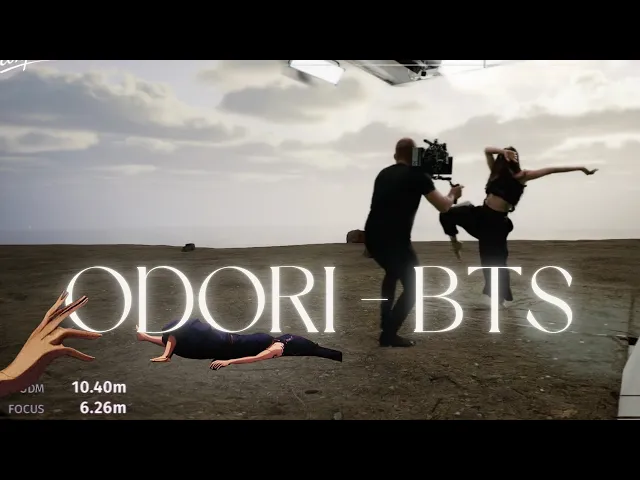
A funded artistic dance short developed with Storyline Studios a& VFX. Originally conceived as a photorealistic virtual production combining live action, motion control and real-time 3D environments.
I taught myself Unreal Engine, built the virtual environments and was part of planning the technical workflow for motion-controlled cameras, green-screen filming and digital backgrounds.
Of financial reasons the VFX house pulled out and the film was left unfinished with green screen backgrounds. I turned to generative AI, researching and building custom local ComfyUI pipelines combining Stable Diffusion 1.5, ControlNet, IP-Adapters and two trained LoRAs.
I rebuilt the film frame by frame, experimenting with visual consistency and creative control across moving sequences.
What began as a photorealistic virtual production became a stylised animated film, completed in 24 FPS, 4K at 3:30 minutes. I also created a full film score for the film experimenting with GenAi music.
Tools: Unreal Engine · ComfyUI · Stable Diffusion 1.5 · ControlNet · IP-Adapter · LoRA training · Hugging Face · Civitai · Suno · Motion Control
Film Fund Viken Film Senter, Norway · Storyline Studios, Oslo
Behind the scenes
Watch the film (3:30)
Borderland
AI Memory layer
Can an AI tool understand your creative process without reading your manuscript?
AI Memory Layer — Borderland R&D
Can AI know your process without reading your book?
Writers won’t share unpublished manuscripts with AI, and they shouldn’t have to. Borderland already captures their daily process notes. Could those become a long-term memory that makes an AI a real creative companion?
I designed a two-vault system that keeps the writer’s words apart from what the AI infers. Every observation cites its source, and a promotion-and-decay engine lets recurring patterns rise.
Then I tried to break it. With Claude Code, I built a test pipeline and ran it against synthetic writers, using sealed answer keys and planted traps. When blind AI grading proved unreliable, I built a claim-by-claim check instead. The result was zero fabricated quotes.
So far: at three months of notes, a stock LLM reading well-structured notes kept pace with the full system. The memory engine hasn’t had a fair test yet.
Next: a custom companion that understands the ritual, memory beyond the context window, and creative connections to literature, film and music.
Ongoing R&D for Borderland.
TypeScript · Claude Code · Codex · Claude · GPT · Gemini · Prompt contracts · Evaluation design

Directing
I love suspending disbelief and developing stories with talented people.
I have directed global campaigns for brands including Adidas, Mercedes-Benz, Timberland Pro, Universal Studios, Netflix and Philips, as well as working as a creative director on a number of projects.
I have always moved comfortably between genres and formats, from traditional film and TVCs to documentary, social and interactive work. A recent campaignfor CLIF Bar in US, has 150 million views on their YouTube channel.
I have been signed to and worked with with Iconoclast, B-reel, Stink for many years, working with talented people from agencies like Wieden+Kennedy Amsterdam, Mother, Heimat and David.
You can see my full directing reel at www.liff.tv but here is a personal short film that grew out of a global adidas campaign I directed and served as co-creative director. It was staff picked by Vimeo and travelled film festivals.
What else?
I played the lead in a Disney film as a kid, which is how I got into filmmaking. I’m Norwegian, grew up between New York, London and Oslo, and have spent years in Berlin and Stockholm.
Under an alias, I make generative AI music videos, release music on Spotify and run weird neural network experiments. I’ve given AI lectures and workshops at SKH and spoken at Filmpool Nord’s Futureday conference.
My wife is a journalist. Her job brought us to London Fields, where we live with our daughter. I may also have catnapped our neighbours’ cat. Neither the people next door nor the cat seem particularly concerned.
I want to help build shiny things that are useful, creative and delight the people who use them. You also get a in-house film, director on the team if needed, to help tell the world about what we make.
Thank you for your time.
Kind regards,
Stian
Get in touch
Stian Smestad
AI Creative Technologist & Film Director